
Pyramid Firms Loan Contracts
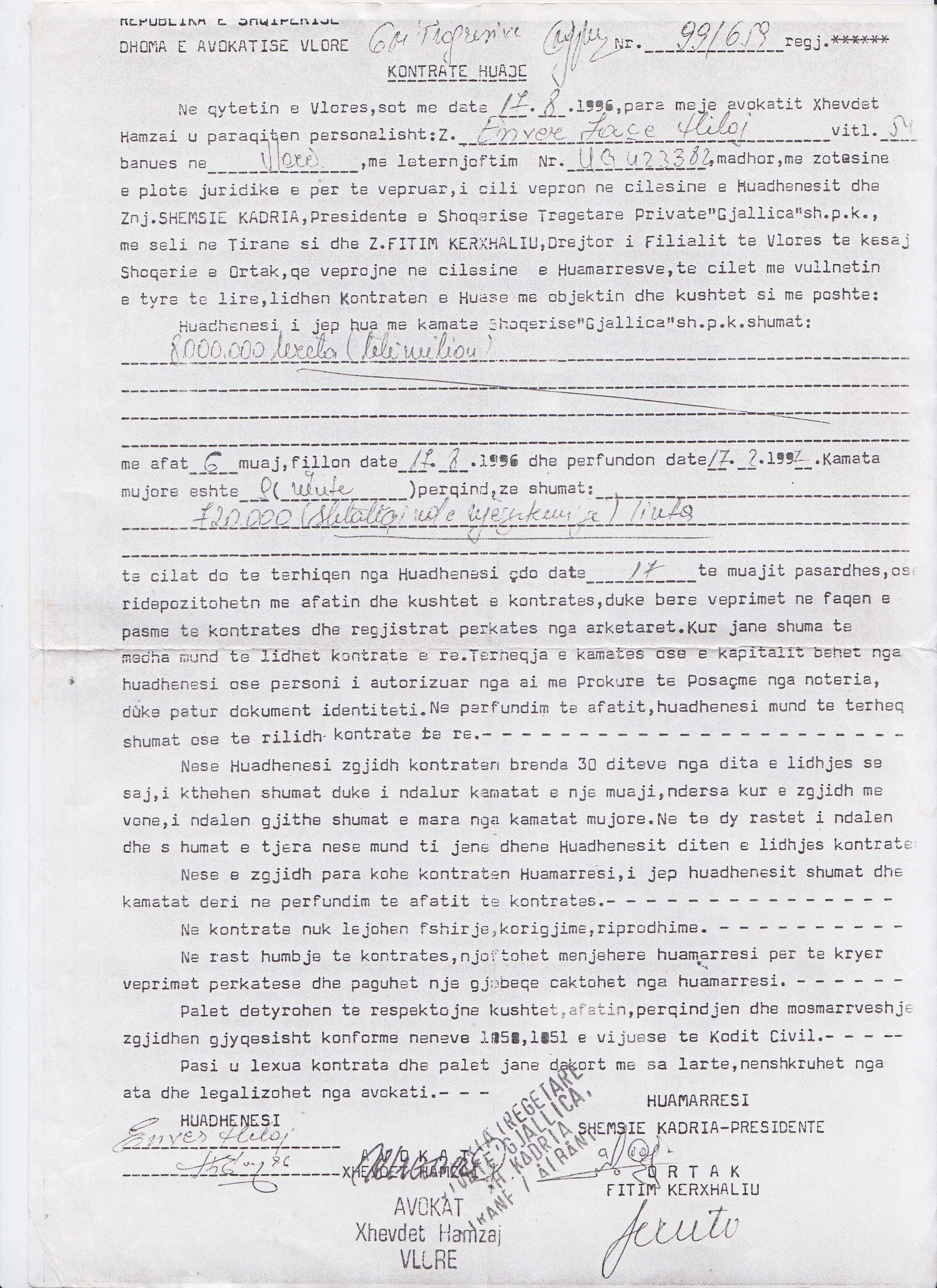
A credit contract (kontrate huaje) from a pyramid firm
*[Pyramid firms] were legitimated by various forms of legal, political, and public discourse.
One such technology of legitimation was the credit contracts (kontrate huaje), issued primarily by the companies (kompani). Kreditorë routinely mentioned credit contracts to prove the legality of their deposits to the firms.
Durim, a former kreditor and sekser (broker) to one of the major kompani, Gjallica, shared his credit contract, dated August 17, 1996 (Fig. 1). In the contract, Durim had “loaned” eight million lek to Gjallica.
Further, the contract contains an important paragraph that references articles 1050 and 1051 of the Civil Code, which spelled out the terms of unbanked moneylending. While this article was misinterpreted by the firms and the cerditors, it lent legitimacy to the transactions with the firms.
In addition to citing the provisions in the Civil Code, kreditorë also recalled how the very act of signing such contracts in the presence of a certified notary public added further legitimacy to fajde.
B: Given that they [pyramid schemes] were registered at the court, that they counted as a juridical person, you could not consider them as illegal (paligjshme). Given that you signed a contract in the presence of a notary public, they seemed legitimate.
For Blerim and many others who echoed a similar sentiment, the legitimacy of fajde was two-fold. First, kompani were legal private entities; they were legally registered as juridical persons. Second, the moneylending was justified under the new Civil Code. Third, the contracts were signed in the presence of a notary public. Altogether, these legal technologies and acts contributed to the legitimacy of the firms in the eyes of the creditors/investors. In other words, a legal infrastructure and set of legal practices constituted the legitimacy of fajde (qua pyramid schemes) in 1990s Albania.
References
Çalışkan, Koray, and Callon, Michel. “Economization, Part 1: Shifting Attention from the Economy towards Processes of Economization.” Economy and Society 38 no. 3 (2009): 369–98.
Callon, Michel, Yuval Millo, and Fabian Muniesa, Market Devices 1st ed. Hoboken: Wiley-Blackwell, 2007